
- English
- 简体中文
- Español
- Português
- русский
- Français
- 日本語
- Deutsch
- tiếng Việt
- Italiano
- Nederlands
- ภาษาไทย
- Polski
- 한국어
- Svenska
- magyar
- Malay
- বাংলা ভাষার
- Dansk
- Suomi
- हिन्दी
- Pilipino
- Türkçe
- Gaeilge
- العربية
- Indonesia
- Norsk
- تمل
- český
- ελληνικά
- український
- Javanese
- فارسی
- தமிழ்
- తెలుగు
- नेपाली
- Burmese
- български
- ລາວ
- Latine
- Қазақша
- Euskal
- Azərbaycan
- Slovenský jazyk
- Македонски
- Lietuvos
- Eesti Keel
- Română
- Slovenski
- मराठी

Optimus Production Line Completed: New Prospects for Engineering Plastics Trade
Tesla’s Optimus humanoid robot production line in Texas is now nearing completion of its main construction. Under the current plan, it will officially start production in 2027 and will also work in coordination with Terafab, a chip project jointly invested in by Tesla and SpaceX. For the engineering plastics industry, the key point of this news is not Tesla itself, but the fact that once humanoid robots enter mass production, the materials side will react first — especially high-performance engineering plastics such as PEEK and PPS.
How Much PEEK Does One Robot Use?
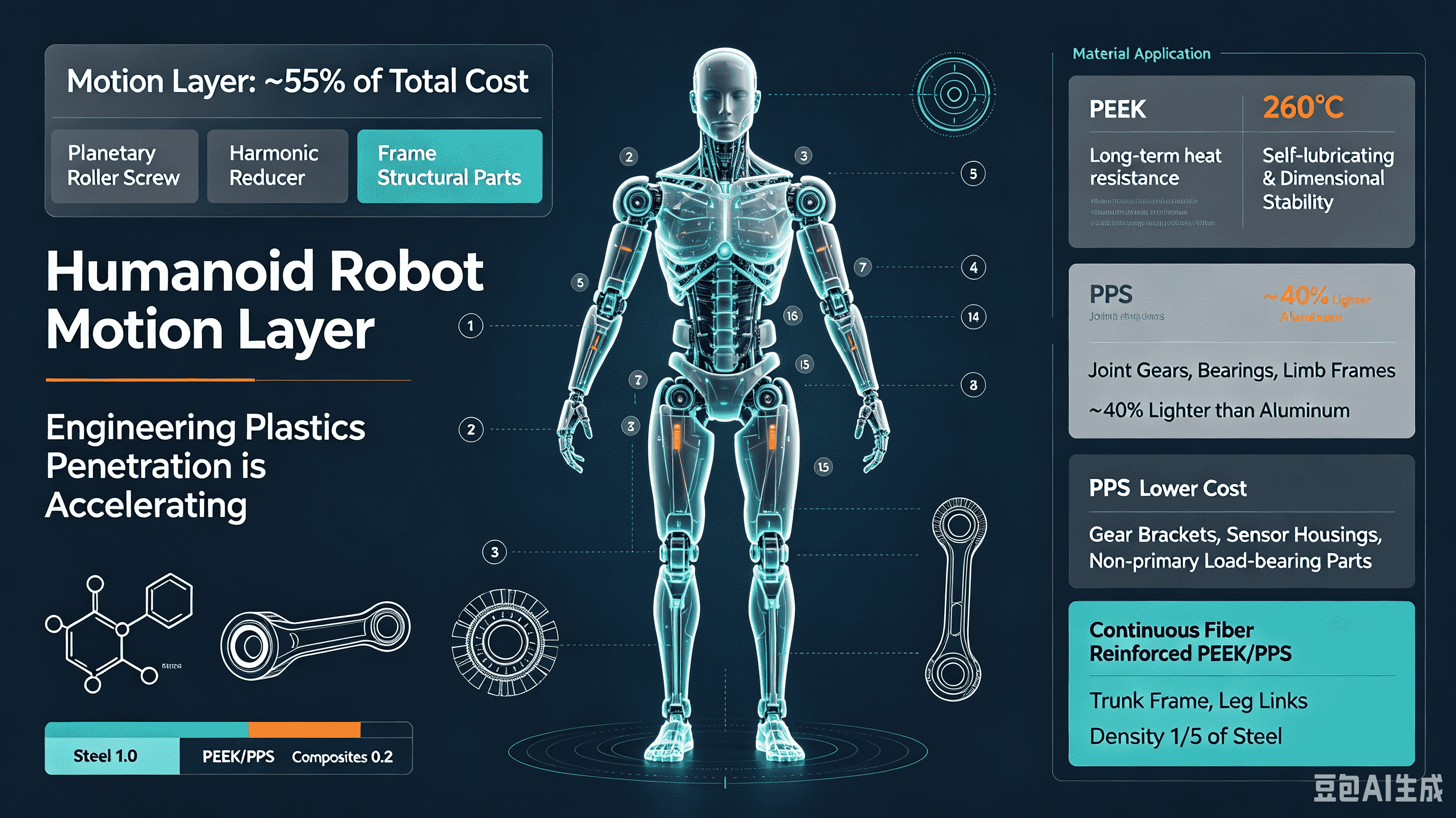
Optimus Gen2 is 10 kg lighter than the first generation, bringing the total weight down to 63 kg. The main approach is to replace metal structural parts with PEEK. Industry estimates put PEEK usage per humanoid robot at around 6.6 to 6.9 kg. If scaled to a million units, that would mean 6,600 to 6,900 tonnes of new PEEK demand per year.
The motion layer of a humanoid robot includes planetary roller screws, harmonic reducers, skeleton structural parts, and other components. It accounts for about 55% of the cost and is also where engineering plastics are penetrating fastest. PEEK has long-term heat resistance of 260°C, good self-lubrication, and stable dimensions. It is suitable for joint gears, bearings, and limb skeletons. Compared with aluminum alloy, it can reduce weight by about 40% while still maintaining sufficient rigidity. PPS costs less and is widely used in gear brackets, sensor housings, and other non-primary load-bearing parts. Continuous fiber reinforced PEEK/PPS can also be used for torso frames and leg links, with a density only one-fifth that of steel.
Terafab Project Is Also Driving Demand
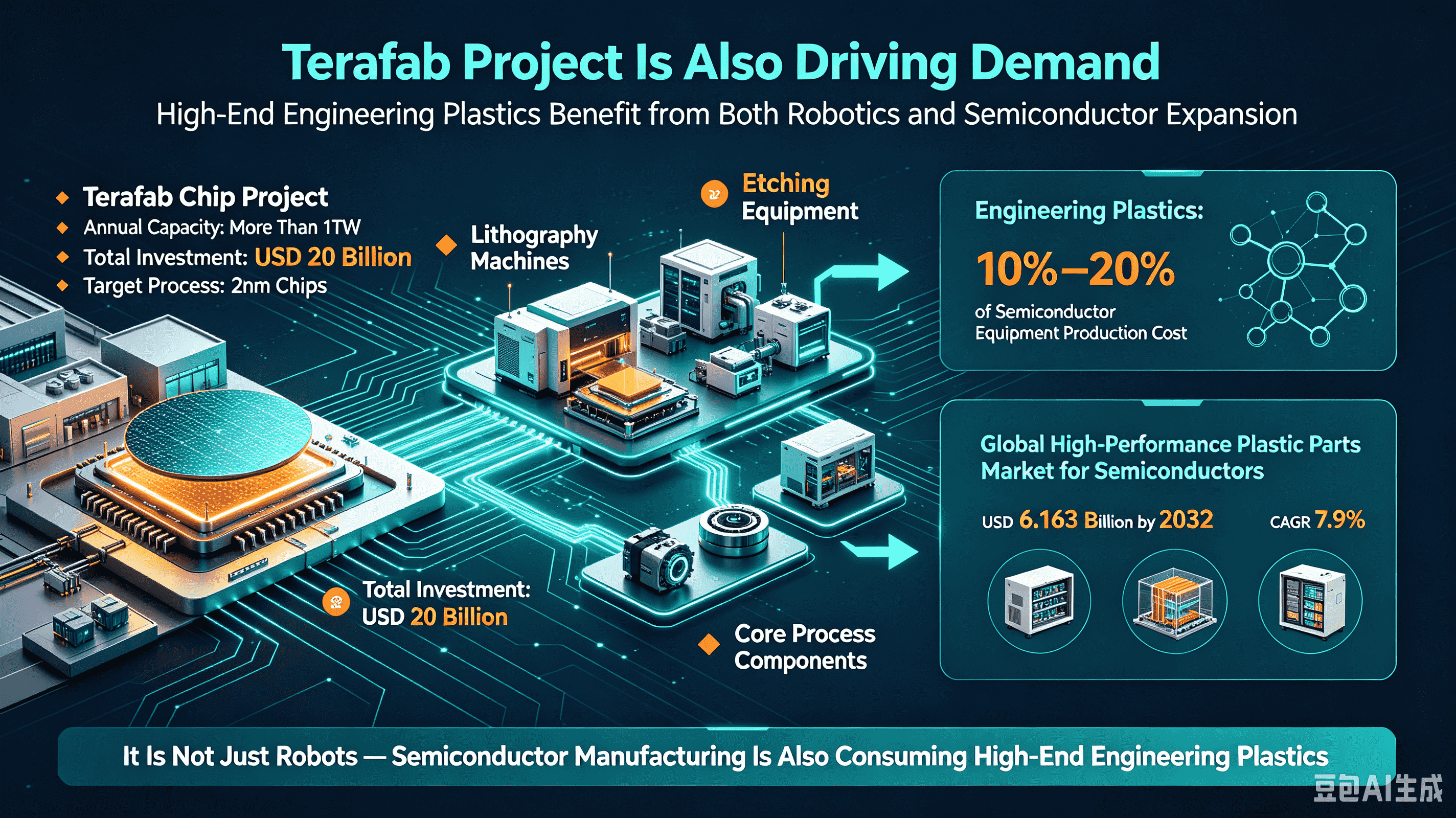
The Terafab chip project, which supports Optimus, targets annual capacity of more than 1TW, with total investment of USD 20 billion and planned production of 2nm chips. In semiconductor equipment and components, engineering plastics account for 10% to 20% of production costs and are used in lithography machines, etching equipment, and other core processes. The global market for high-performance plastic parts used in semiconductors is expected to reach USD 6.163 billion by 2032, with a CAGR of 7.9%. So it is not just robots — semiconductor manufacturing is also consuming high-end engineering plastics.
Imported Materials Still Dominate
Global supply of specialty engineering plastics is fairly concentrated. Take PEEK as an example: Victrex of the UK, Solvay of Belgium, and Evonik of Germany together account for about 65% of global capacity. More than 80% of demand in China’s high-end market relies on imports, and the overall import dependence of specialty engineering plastics remains above 70%. Domestic companies are expanding capacity. Publicly disclosed planned capacity for PEEK and integrated new plants in 2026 has exceeded 30,000 tonnes per year, but high-end grades will still mainly rely on imports in the short term.
China’s PEEK imports in 2026 are expected to reach 4,800 tonnes, while exports of compound-grade PEEK are expected to be around 1,400 tonnes, showing some processing trade characteristics. Imported PEEK prices have long remained in the range of RMB 800,000 to 1,000,000 per tonne. Domestic material has a 20% to 30% price advantage, but high-end applications still prefer imported material.
What Can Import Traders Do in Advance?
For companies in the imported engineering plastics trade, there are several things that can be done ahead of time.
First, do not spread product categories too thin. Around robot joints, skeletons, and sensor housings, focus on PEEK virgin resin, modified PEEK, reinforced PPS grades, and continuous fiber reinforced thermoplastic composites.
Second, keep the supply chain stable. Maintain close cooperation with international suppliers such as Victrex, Solvay, and Evonik. When demand concentrates and surges, whether you can get priority access to goods is critical.
Third, technical service must keep up. Robot customers have strict requirements for heat resistance, self-lubrication, and dimensional accuracy. Quoting a price alone is not enough. You also need to help customers select materials and connect with processing technology. Moving from selling raw materials to helping customers solve material problems makes orders more stable.
As the Optimus production line and Terafab project move forward, humanoid robots are moving from concept to mass production at the level of tens of thousands to millions of units. Demand for high-performance engineering plastics is not a short-term concept. For companies in the imported engineering plastics trade, now is the time to start sorting out grades, suppliers, and customer directions, and to get a clear picture of what goods and lead times they can secure.