
- English
- 简体中文
- Español
- Português
- русский
- Français
- 日本語
- Deutsch
- tiếng Việt
- Italiano
- Nederlands
- ภาษาไทย
- Polski
- 한국어
- Svenska
- magyar
- Malay
- বাংলা ভাষার
- Dansk
- Suomi
- हिन्दी
- Pilipino
- Türkçe
- Gaeilge
- العربية
- Indonesia
- Norsk
- تمل
- český
- ελληνικά
- український
- Javanese
- فارسی
- தமிழ்
- తెలుగు
- नेपाली
- Burmese
- български
- ລາວ
- Latine
- Қазақша
- Euskal
- Azərbaycan
- Slovenský jazyk
- Македонски
- Lietuvos
- Eesti Keel
- Română
- Slovenski
- मराठी

Automotive Recycled Plastics Enter the "Mandatory Compliance" Era: How Should Import Traders Respond to LG Chem and Volkswagen's Move?
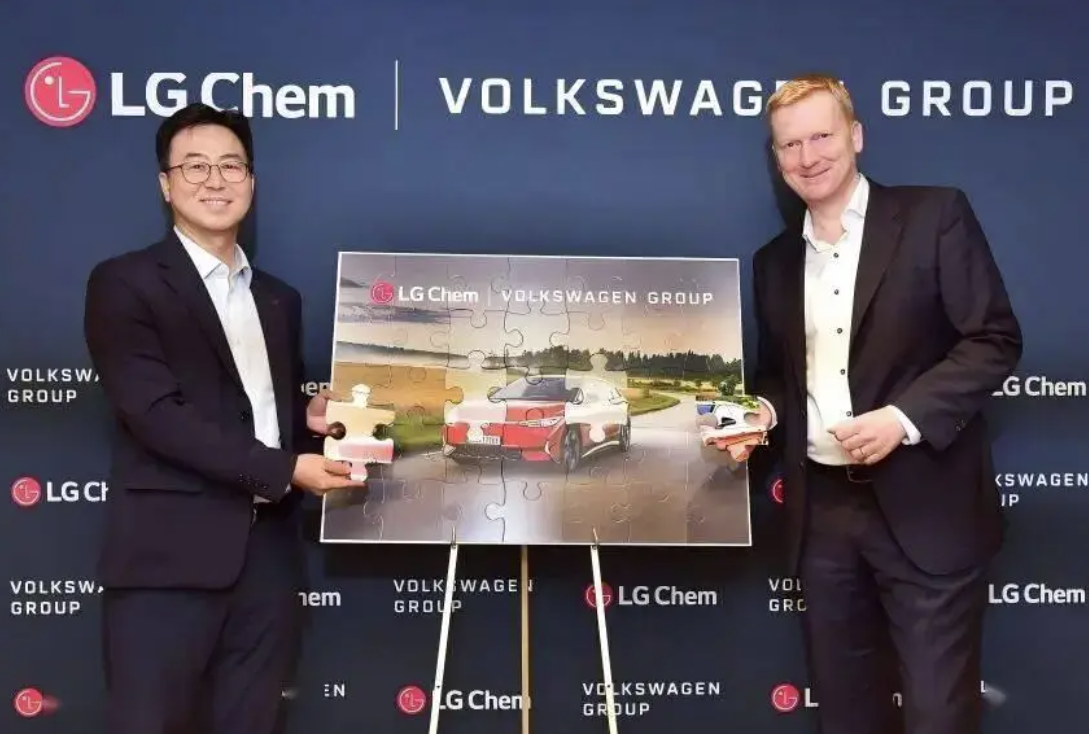
On September 28, 2026, LG Chem and Volkswagen Group signed a memorandum of understanding in Seoul to jointly develop next-generation eco-friendly mobility materials. Under the agreement, the cooperation will be based on LG Chem's ABS (acrylonitrile-butadiene-styrene copolymer) and engineering plastics, promote vehicle lightweighting and performance improvement, and simultaneously assess the feasibility of applying post-consumer recycled (PCR) materials and cost-competitive material solutions to interior and exterior components of vehicles under Volkswagen's major brands. LG Chem currently has an annual ABS production capacity of 2.35 million tons globally and, as early as 2020, was the first to achieve industrial-scale mass production of white PCR ABS.
This news may appear to be a technical cooperation between two giants, but for companies like us engaged in the trade of imported engineering plastic raw materials, it sends a clear supply chain signal: automotive recycled plastics are moving from a "bonus item" to an "admission requirement," and importers of raw materials are not bystanders in this shift but an indispensable link in the chain.
Regulations Force the Shift: Recycled Plastic Content Is No Longer a Multiple-Choice Question
The core force driving this shift comes from the European Union. The new End-of-Life Vehicles (ELV) law, which formally took effect in August 2026, stipulates that from September 1, 2032, plastics used in new vehicle models receiving type approval must contain at least 15% recycled plastic; by 2036, this proportion will rise to 25%, of which at least 20% must come from closed-loop recycling of end-of-life vehicles. This means that for any automaker and its supply chain planning to enter the EU market, the use of recycled plastics is no longer a question of "whether to do it" but of "how to do it in compliance."
At the domestic level in China, the group standard for the use of automotive recycled plastics issued in January 2026 has already set clear provisions on the classification requirements, legality of sources, labeling specifications, and traceability of recycled plastics. It requires vehicle plastic parts weighing more than 100 g to be labeled, in accordance with the standard, with the type of recycled plastic and the "REC ratio." A stable supply of compliant recycled raw materials is becoming a real bottleneck for automakers and Tier 1 suppliers.
The Trader's Position: The "Organizer" and "Filter" of Compliant Raw Materials
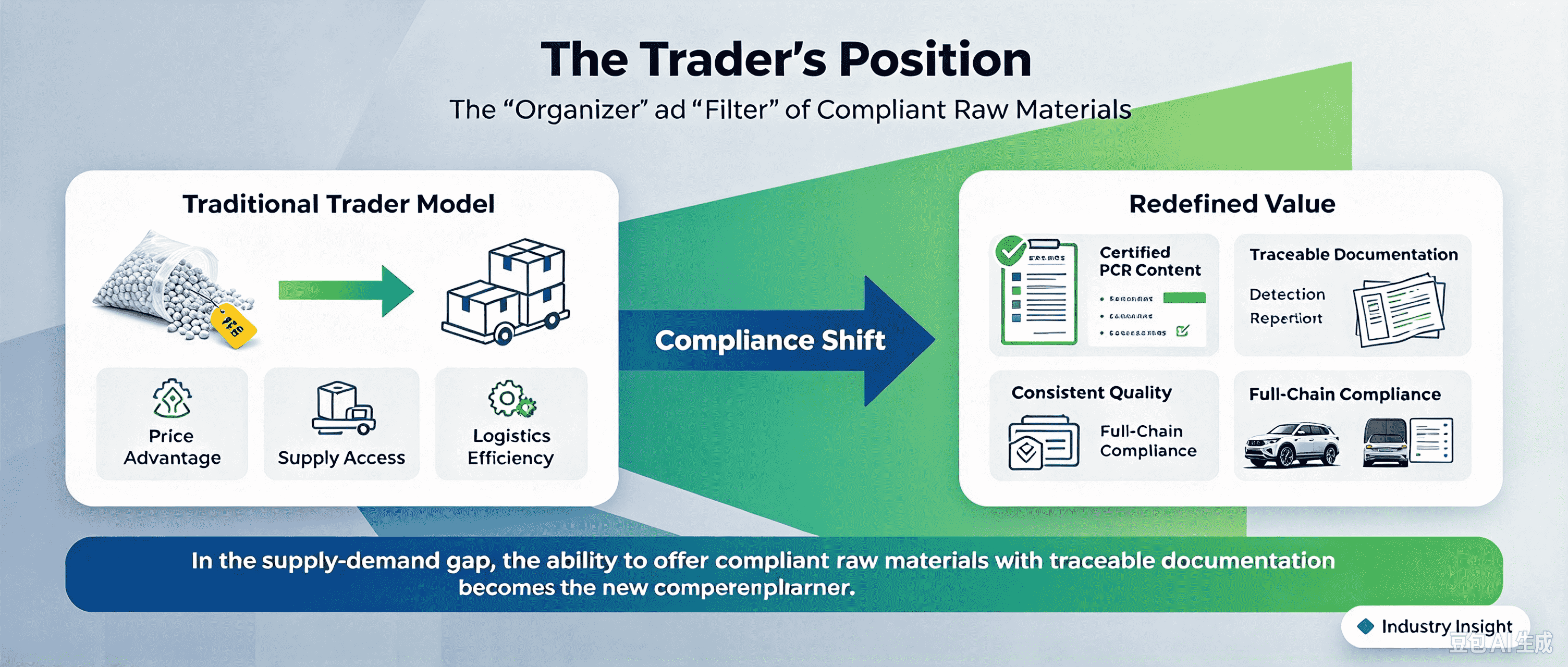
In this supply-demand gap, the value of import traders of engineering plastic raw materials is being redefined. Under the traditional model, a trader's core capabilities were price, supply sources, and logistics efficiency; under the trend toward compliance in recycled materials, "whether one can provide compliant raw materials with traceable documentation" is becoming a new competitive barrier.
The reason LG Chem's PCR ABS portfolio can enter Volkswagen's evaluation system is not the use of recycled material per se, but that its white PCR ABS has automotive-grade color consistency and performance stability while also providing a complete source traceability chain. The same logic applies to PC/ABS alloys—Covestro's Bayblend material containing 35% PCR content has been adopted for interior parts of the Toyota Lexus ES, backed by full-chain compliance capabilities from raw material sourcing to performance validation.
For import traders, this means several things need to be planned in advance: First, screen overseas suppliers with automotive-grade PCR certification, and prioritize stable partnerships with factories that can provide third-party certifications such as GRS and ISCC PLUS. Second, build in-house material traceability archiving capabilities, systematically managing the source, content calculation basis, and compliance documents of each batch of imported recycled material, so as to provide downstream customers with a complete chain of compliance evidence. Third, pay attention to PCR versions of mainstream automotive grades such as PC/ABS and ABS, because interior and exterior parts are precisely the scenarios where recycled plastics will first achieve scaled application.
The Window Is Limited; Compliance Capability Is Bargaining Power
The EU ELV regulation's methodology for calculating recycled content will not be further clarified until after 2028, but automakers' material selection and supplier certification cycles often last 18 to 24 months. This means the truly meaningful window for positioning is within the next one to two years. Whoever can, at this stage, be the first to establish import channels and a traceability system for compliant PCR raw materials may occupy an irreplaceable position in the next round of supply chain restructuring for automotive engineering plastics.
The cooperation between LG Chem and Volkswagen is only the beginning. When mandatory recycled plastic ratios move from legal text to every vehicle's BOM, traders that can stably deliver imported engineering plastic raw materials "with an identity" will no longer be simple intermediaries, but infrastructure for the compliant supply chain.