
- English
- 简体中文
- Español
- Português
- русский
- Français
- 日本語
- Deutsch
- tiếng Việt
- Italiano
- Nederlands
- ภาษาไทย
- Polski
- 한국어
- Svenska
- magyar
- Malay
- বাংলা ভাষার
- Dansk
- Suomi
- हिन्दी
- Pilipino
- Türkçe
- Gaeilge
- العربية
- Indonesia
- Norsk
- تمل
- český
- ελληνικά
- український
- Javanese
- فارسی
- தமிழ்
- తెలుగు
- नेपाली
- Burmese
- български
- ລາວ
- Latine
- Қазақша
- Euskal
- Azərbaycan
- Slovenský jazyk
- Македонски
- Lietuvos
- Eesti Keel
- Română
- Slovenski
- मराठी

NVIDIA Pushes PTFE into the Spotlight, but PCB Yield Remains Below 10%: What Should Engineering Plastics Importers Really Watch?
Lead: On one side, capital markets are chasing the concept. On the other, production lines are reporting yields below 10%. The PTFE–NVIDIA story is moving from “will they use it?” to a much harder question: “can PCB makers actually build it?” For importers of engineering plastics raw materials, the more important signals are material validation, hybrid stack-up adoption, and supply-chain timing—not just the heat of the narrative.
1. Capital markets moved first: PTFE has become the most visible “plastics–NVIDIA” link
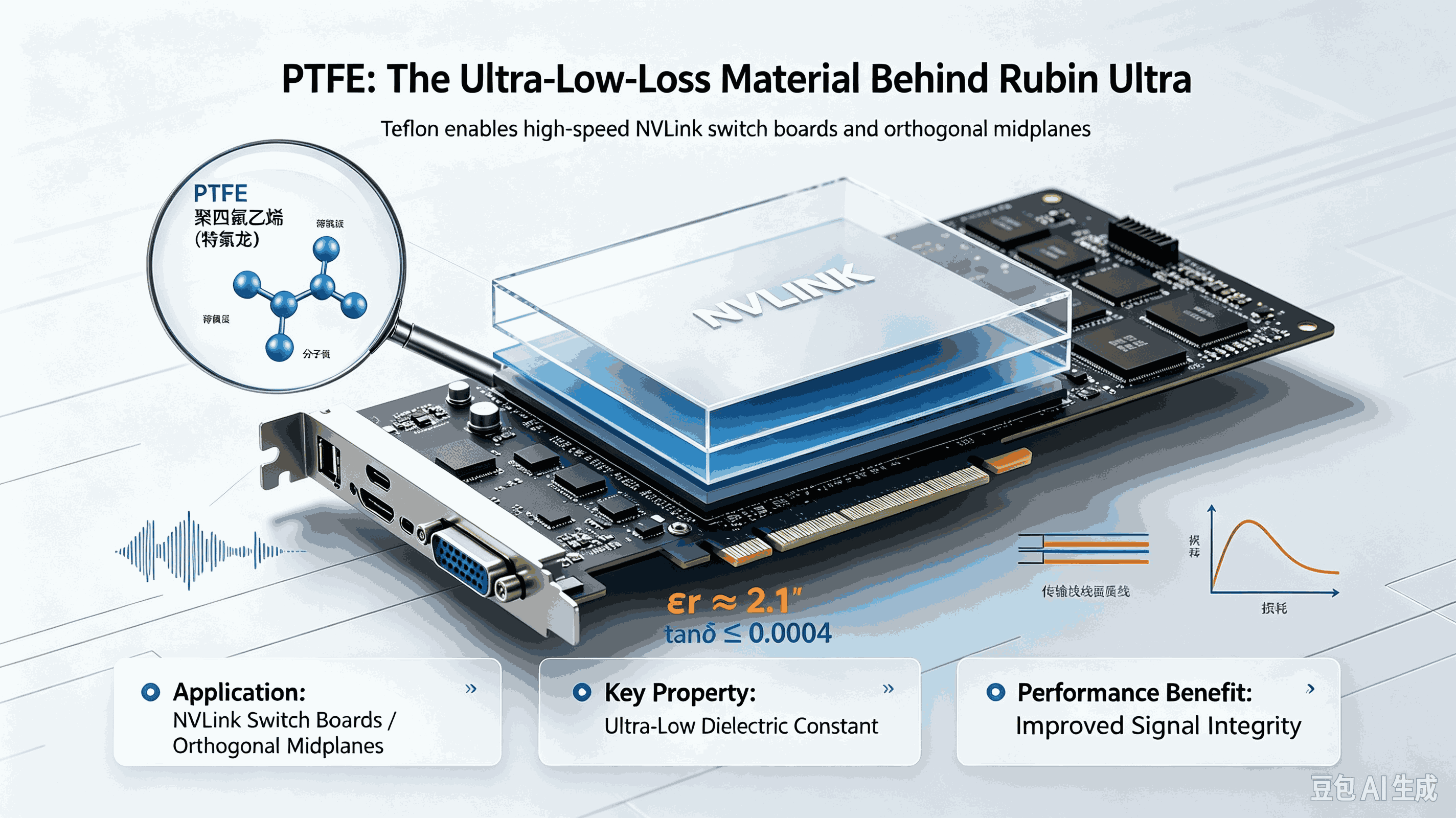
AI chip interconnect speeds are pushing toward 200Gbps and even 448Gbps. Conventional epoxy resin and M9-class resin systems are beginning to struggle with dielectric loss at such high frequencies, making signal attenuation a physical-layer bottleneck. NVIDIA is evaluating PTFE for NVLink switch boards or orthogonal midplanes in its next-generation Rubin Ultra platform, attracted by its ultra-low-loss characteristics: a dielectric constant of about 2.1 and a dissipation factor as low as 0.0004.
Capital markets reacted faster than engineering progress. Wote Advanced Materials, which carries both a “PTFE concept” and an “NVIDIA concept” tag, hit the daily limit on November 11; its industry classification is plastics. The PTFE concept sector rose 4.03% that day. Earlier, in October, Taiwan’s Taiflex and Flexium also hit limit-up after appearing on NVIDIA’s NVLink PTFE Board display board. The market is already pricing this “plastics–NVIDIA” link with real money.
2. Engineering reality: the question is now “can PCB makers build it?”
But heat is not mass production. According to feedback from institutional investors’ checks with some of NVIDIA’s PCB partners in late October 2026, PTFE board manufacturing yield at these companies is below 10%; industry estimates are even below 5%. PTFE is soft and has a relatively high coefficient of thermal expansion, making boards prone to misalignment and warpage. Drilling and lamination are significantly more difficult than with glass-fiber-based substrates.
On October 20, Taiwan’s Elite Material said plainly: “Customers proposed this material three years ago, but no one has adopted it in thirty years—there must be a reason.” In 2026, the mainstream is still M8, with M10 only being introduced at year-end. NVIDIA’s NVLink board display at the OCP Summit pushed the narrative heat very high, but production-line reality is pulling the pace back.
3. The approach is converging: pure PTFE is not the endpoint—hybrid stack-ups are the current path
A more important change is that NVIDIA’s own material approach is converging from “full replacement” toward “hybrid stack-ups.” SemiAnalysis noted in its August report that on NVSwitch boards, NVIDIA does not want pure PTFE, but a hybrid architecture of PTFE core plus M9 prepreg. A November 11 research note from Zheshang Securities further confirmed this path: the current hybrid solution uses a PTFE core layer with M9 prepreg; Shengyi Technology and Taiflex are advancing from the copper-clad laminate side, while Kinwong and Shengyi Electronics handle high-layer processing.
A pure PTFE solution requires process temperatures above 300°C. Demand for lamination equipment needed for all-PTFE boards is expected to lag material-side release. Glass-free PTFE copper-clad laminates have entered substantive validation, and NVIDIA displayed seven copper-clad laminate and PCB manufacturers at the 2026 OCP Summit. At the same time, alternative paths such as ABF film and hydrocarbon resin are also being evaluated. This means material validation is moving forward, but equipment and process support remain delayed.
4. Implications for engineering plastics raw material importers
For companies importing engineering plastics raw materials, the value of this story is not in chasing limit-up stocks, but in three “certainties”:
First, demand for low-loss materials in high-frequency, high-speed applications is certain. PTFE, LCP, PPO/PPE, hydrocarbon resin, and related material families will all benefit, but the timing is clearly differentiated. LCP is already in mass supply for 224Gbps high-speed connectors; PTFE is still in validation.
Second, hybrid stack-ups create “combination supply” opportunities. What customers need is not a single PTFE material, but the matching of PTFE cores, M9 prepreg, low-loss resins, and processing know-how. Importers should prepare in advance: material data, compliance documents, and sample support capabilities.
Third, overseas customers value verifiable supply chains. PCB and connector customers abroad will not listen only to concepts. They will ask about yield, coefficient of thermal expansion, lamination windows, and batch-to-batch consistency. Only suppliers that can provide complete technical documentation and stable supply have a chance to enter the validation list.
Conclusion: It is true that PTFE has been pushed into the spotlight by NVIDIA, but it is also true that yield remains below 10%. The relationship between the plastics industry and NVIDIA is moving from “whoever has the label rallies” to a differentiation stage defined by “who has shipments, who passes validation, and who can withstand yield pressure.” For engineering plastics raw material importers, discipline is worth more than heat.