
- English
- 简体中文
- Español
- Português
- русский
- Français
- 日本語
- Deutsch
- tiếng Việt
- Italiano
- Nederlands
- ภาษาไทย
- Polski
- 한국어
- Svenska
- magyar
- Malay
- বাংলা ভাষার
- Dansk
- Suomi
- हिन्दी
- Pilipino
- Türkçe
- Gaeilge
- العربية
- Indonesia
- Norsk
- تمل
- český
- ελληνικά
- український
- Javanese
- فارسی
- தமிழ்
- తెలుగు
- नेपाली
- Burmese
- български
- ລາວ
- Latine
- Қазақша
- Euskal
- Azərbaycan
- Slovenský jazyk
- Македонски
- Lietuvos
- Eesti Keel
- Română
- Slovenski
- मराठी

A Full Property Review of Lexan 3412R: V-0, CTI 150V, HDT 139°C, and an Application Guide for Electrical & Electronics
When many purchasers and engineers select flame-retardant PC, their first question is often only, “Is it V-0?” But in actual mass production, the real problems often lie elsewhere: insufficient CTI, inadequate heat-resistance margin, short shots in thin walls, failure in long-term heat aging, or unstable dimensions. Today, based on the property data sheet of SABIC Lexan Resin 3412R , let’s clarify what kind of application scenarios this “high-rigidity + flame-retardant + heat-resistant + electrically insulating” engineering plastic is truly suitable for. The data are typical values; normal tolerances may vary by color. For material selection, refer to the official data sheet and UL Yellow Card.
I. Product Positioning: Not Ordinary Flame-Retardant PC, but High-Rigidity Flame-Retardant PC
Lexan 3412R has a tensile modulus of 6000 MPa, flexural modulus of 5500 MPa, tensile stress at break of 90 MPa, flexural stress at break of 120 MPa, density of 1.35 g/cm³, and molding shrinkage of 0.2%–0.5%. These figures show that it is “harder” and more deformation-resistant than ordinary PC, making it suitable for structural support parts, thin-wall housings, and precision electrical components. Notched impact is 7 kJ/m² (23°C), and unnotched impact is 35 kJ/m². This is a rigidity-first formulation with moderate toughness, so sharp notches should be avoided in structural design.
II. Flame Retardancy and Heat Resistance: The Safety Baseline for Electrical & Electronic Parts
It meets UL Recognized 94V-0 (1.5 mm) and has an oxygen index of 37%; the Glow Wire Flammability Index passes 850°C at 1 mm and 960°C at 1.6 mm; the Ball Pressure Test passes at 125°C. In terms of heat resistance, HDT/Ae at 1.8 MPa is 139°C, HDT/Be at 0.45 MPa is 144°C, and Vicat softening temperature is 155°C at A/50 and 147°C at B/50; the Relative Temperature Index (RTI) is 130°C for electrical, 125°C for mechanical with impact, and 130°C for mechanical without impact. This means it can maintain rigidity in many electrical scenarios close to heat sources and leave margin for safety-certification compliance.
III. Electrical Performance: CTI 150V and Stable Insulation
Volume resistivity and surface resistivity are both >1.E+15 Ohm-cm/Ohm; short-time dielectric strength is 20 kV/mm at 1.0 mm, and in oil it is 33 kV/mm at 0.8 mm, 25 kV/mm at 1.6 mm, and 16 kV/mm at 3.2 mm; relative permittivity is 3 at 50/60 Hz and 2.9 at 1 MHz, with dissipation factors of 0.001 and 0.01, respectively; CTI is 150V. It is suitable for low-voltage electrical appliances, connectors, power-supply housings, and other parts with requirements for insulation and tracking resistance.
IV. Detailed Breakdown of Application Areas
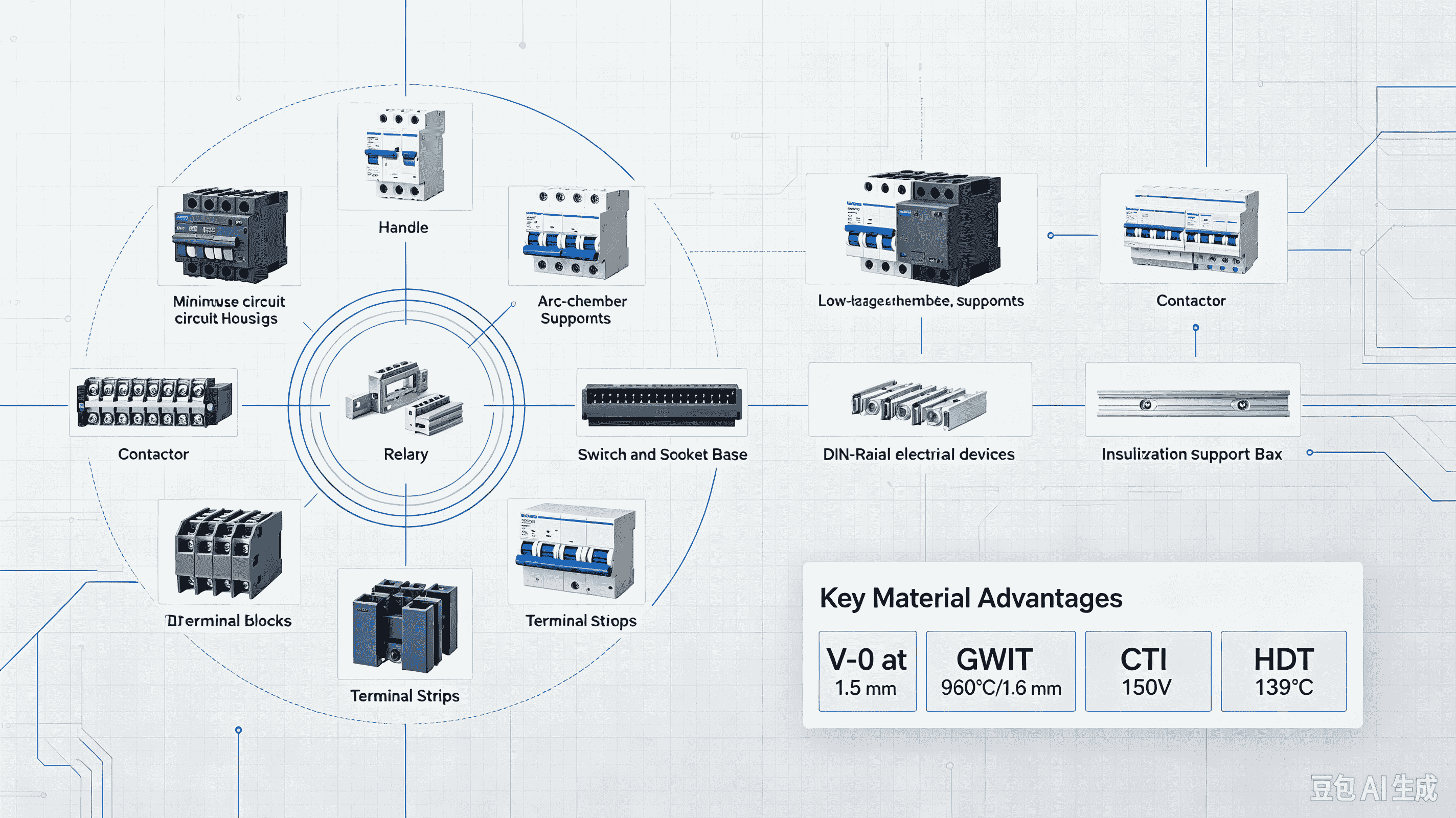
1. Low-Voltage Electrical Appliances and Power Distribution: Miniature circuit breaker housings/handles/arc-chamber supports, contactors, relays, switch and socket bases, terminal blocks, terminal strips, DIN-rail electrical devices, insulating support parts in distribution boxes. The key advantages are V-0 at 1.5 mm, GWIT 960°C/1.6 mm, CTI 150V, and HDT 139°C.
2. Power Supplies and Connectors: Power adapter/charger housings, connectors, transformer bobbins, coil bobbins, capacitor housings, battery boxes, and fuse holders. High rigidity and low shrinkage can reduce thin-wall deformation, while electrical insulation data support safety design.
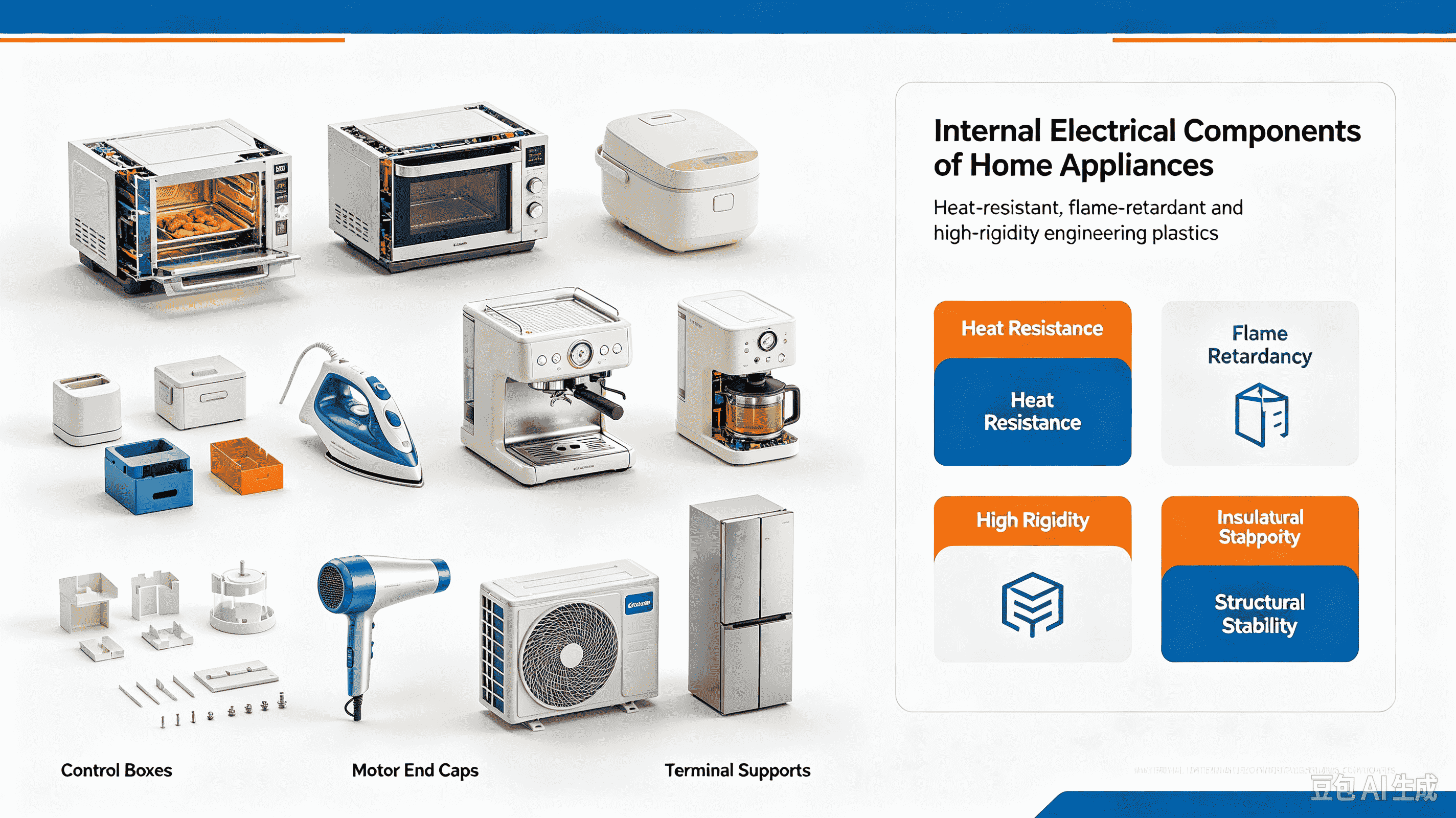
3. Internal Electrical Components of Home Appliances: Control boxes, motor end caps, terminal supports, etc., for microwaves, ovens, rice cookers, coffee machines, irons, hair dryers, air conditioners, and refrigerators. Heat resistance and flame retardancy are core requirements, and high rigidity enables structural parts.
4. Automotive Electronics: Connectors, fuse boxes, sensor housings, internal electrical brackets for automotive lighting, etc. These must be separately validated according to OEM material specifications.
5. Industrial Control, Security, and Medical Power Supplies: Industrial control equipment housings, terminal blocks, motor controllers, security equipment housings, and medical equipment power-supply housings. Flame retardancy, heat resistance, and dimensional stability are key selection criteria.
V. Processing Essentials: Do Not Skip Drying and Mold Temperature
Before injection molding, dry at 120°C for 2–4 hours, with moisture content controlled at ≤0.02%; melt temperature 290–320°C, nozzle 280–310°C, front/middle/rear zone temperatures 290–320/280–310/270–300°C, hopper 60–80°C, and mold temperature 80–120°C. Moldflow flow analysis (melt 300°C, mold 90°C) indicates that if gate pressure is greater than 80 MPa, it is recommended to contact technical support. MVR is 6 cm³/10 min (300°C/1.2 kg), suitable for medium flow-length, high-rigidity structural parts. For thin-wall, long-flow-length parts, flow simulation should be performed in advance.
Conclusion: Lexan 3412R is suitable for electrical and electronic structural parts where the four requirements of “flame retardancy + heat resistance + high rigidity + electrical insulation” coexist. When selecting materials, do not compare only prices; first check the safety-certification thickness, CTI, RTI, and processing window. As an importer and trader of engineering plastic raw materials, we can provide the Lexan 3412R data sheet, UL Yellow Card, processing recommendations, and sample support. Engineers and purchasers are welcome to contact us for material selection discussions.
Send Inquiry
Related Products