
- English
- 简体中文
- Español
- Português
- русский
- Français
- 日本語
- Deutsch
- tiếng Việt
- Italiano
- Nederlands
- ภาษาไทย
- Polski
- 한국어
- Svenska
- magyar
- Malay
- বাংলা ভাষার
- Dansk
- Suomi
- हिन्दी
- Pilipino
- Türkçe
- Gaeilge
- العربية
- Indonesia
- Norsk
- تمل
- český
- ελληνικά
- український
- Javanese
- فارسی
- தமிழ்
- తెలుగు
- नेपाली
- Burmese
- български
- ລາວ
- Latine
- Қазақша
- Euskal
- Azərbaycan
- Slovenský jazyk
- Македонски
- Lietuvos
- Eesti Keel
- Română
- Slovenski
- मराठी

MG47F: The ABS That Wins by Being “Just Right”—Why It’s a Go-To Workhorse for Injection Molders
In injection molding, one of the most expensive hidden costs is choosing the wrong material. High-impact grades often resist flow; high-flow grades can be brittle. Food-contact grades may fall short on heat resistance; heat-resistant grades may fail certification. Purchasing teams bounce between price and compliance, while the shop floor keeps fighting with machine settings and scrap rates.
CYCOLAC™ MG47F exists to remove that friction. SABIC defines it simply as a multi-purpose injection molding grade of ABS, FDA compliant. But behind that plain description is a carefully restrained balancing act.
It Is Not a “Six-Sided Warrior,” but Every Box Is Within Range
Start with the mechanical foundation. A flexural modulus of 2,300 MPa (ASTM D790) gives parts the stiffness and dimensional stability they need—housings do not collapse under finger pressure, and assembly gaps stay controllable. Paired with that is a Charpy notched impact strength of 26 kJ/m² (23°C, ISO 179), which sits in the upper-middle range for general-purpose ABS. It is enough to absorb assembly stress and everyday drops, without sacrificing flow just to chase extreme impact numbers.
What really makes MG47F popular on the shop floor is its flow profile. At 220°C/10 kg, the melt flow rate is 18 g/10 min. At 240°C and a shear rate of 1,000 s⁻¹, melt viscosity is 225 Pa·s—a flow configuration that can handle long flow paths and thin walls without pushing clamp force and injection pressure to their limits. It does not compete with high-flow specialty grades for extreme thin-wall jobs, but it lets most medium-complexity molds run stably and quickly.
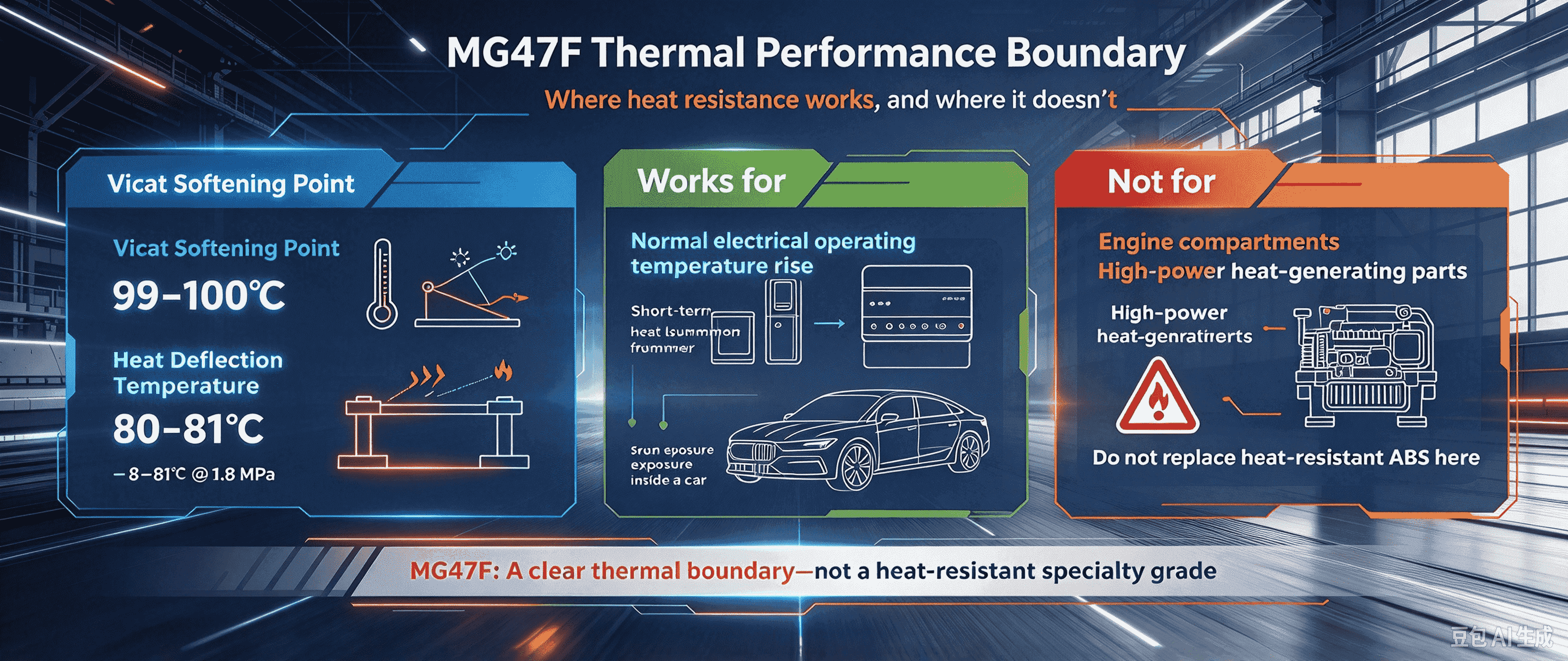
On thermal performance, the Vicat softening point is 99–100°C, and the heat deflection temperature under 1.8 MPa load is 80–81°C. That means it can handle normal electrical operating temperature rise and short-term heat load from summer sun exposure inside a car, but it should not be expected to replace heat-resistant ABS in engine compartments or high-power heat-generating parts. Its thermal boundary is clearly drawn.
FDA Compliance: Not a Bonus, but an Entry Ticket
The “F” in MG47F is not decoration. SABIC’s product catalog explicitly lists it as FDA compliant, and it also meets RoHS/REACH environmental requirements.
The more practical value is that it combines compliance with appearance. High-gloss surface, easy painting, easy electroplating, and high impact without whitening—for consumer goods and automotive interior appearance parts that need a quality feel, these characteristics stack on top of an FDA foundation. That means one material can cover orders that require “safe inside and good-looking outside.” The worst situation in trading is when a customer comes with a food-contact requirement but also demands appearance-grade surface quality. MG47F fills exactly that gap.
Processing Window: Forgiving, but Not Careless
The TDS gives a sufficiently wide injection molding window: melt temperature 220–260°C, mold temperature 50–70°C, drying at 80–95°C for 2–4 hours, maximum moisture content 0.1%. The rear barrel zone can even start at 190°C, leaving a gentle compression transition for the screw.
But two numbers deserve a second look from the shop floor. Back pressure: 0.3–0.7 MPa—on the low side. This is not a suggestion to skip back pressure; it tells you that this material’s melt strength does not need high back pressure to “pack” it. Excessive back pressure may instead bring unnecessary shear heat and residual stress. Vent depth: 0.038–0.051 mm—a relatively narrow range. Too deep and you get flash; too shallow and trapped gas causes burning. When the mold condition is not right, MG47F will remind you with silver streaks and burn marks that drying and venting have problems. Shrinkage of 0.5–0.8% is within the normal ABS band, but for dimensionally sensitive parts, that range still needs to be narrowed to 0.1% accuracy through mold flow analysis and trial shots.
Who It Fits—and Who It Does Not
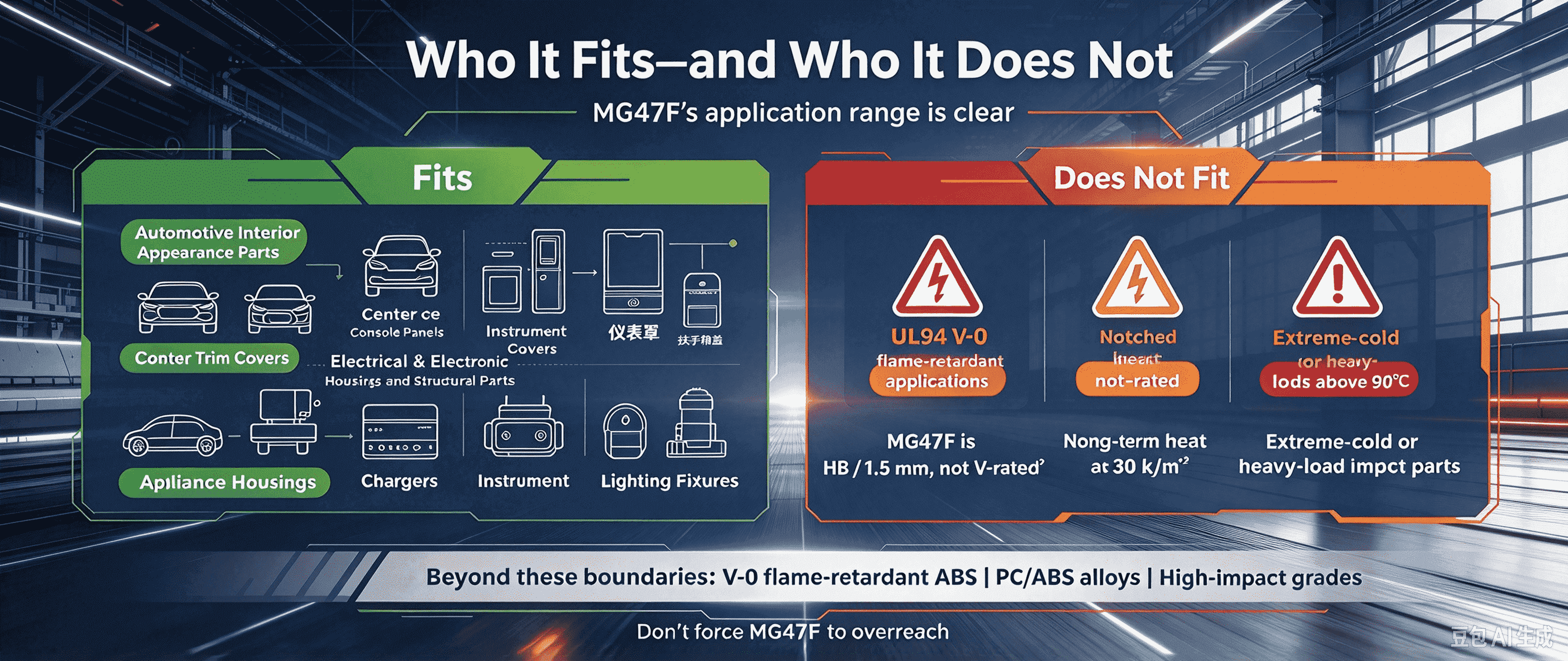
Looking at application scenarios, MG47F’s range is very clear: automotive interior appearance parts (center console panels, door trim covers, instrument panel covers, armrest box lids), electrical and electronic housings and structural parts (appliance housings, chargers, instrument housings, lighting fixtures).
What it does not fit is equally clear: flame-retardant applications requiring UL94 V-0 (MG47F is HB / 1.5 mm, not V-rated); long-term heat loads above 90°C; and extreme-cold or heavy-load impact parts requiring notched impact strength above 30 kJ/m². Outside those boundaries, you should look for V-0 flame-retardant ABS, PC/ABS alloys, or high-impact grades—not force MG47F to overreach.
Quick Selection Guide
If your order hits two or more of the following three conditions—requires FDA food-contact compliance, the part has a medium-complexity flow path or thin-wall areas, and the appearance surface requires high gloss, paintability, or no whitening—MG47F should enter your first-round trial list. Competing benchmarks such as Chi Mei PA-757 and Formosa AG15E1 each have their own strengths, but MG47F’s completeness at the intersection of “food compliance + impact-flow balance + high-gloss appearance” is the fundamental reason it keeps getting named on the trading side.
An ABS that does not chase single-category championships, but keeps every item above the pass line, has become hard currency among general-purpose grades. For injection molders and buyers, avoiding one wrong choice is worth far more than gaining one extreme parameter.