
- English
- 简体中文
- Español
- Português
- русский
- Français
- 日本語
- Deutsch
- tiếng Việt
- Italiano
- Nederlands
- ภาษาไทย
- Polski
- 한국어
- Svenska
- magyar
- Malay
- বাংলা ভাষার
- Dansk
- Suomi
- हिन्दी
- Pilipino
- Türkçe
- Gaeilge
- العربية
- Indonesia
- Norsk
- تمل
- český
- ελληνικά
- український
- Javanese
- فارسی
- தமிழ்
- తెలుగు
- नेपाली
- Burmese
- български
- ລາວ
- Latine
- Қазақша
- Euskal
- Azərbaycan
- Slovenský jazyk
- Македонски
- Lietuvos
- Eesti Keel
- Română
- Slovenski
- मराठी

Behind China’s BCI Standards Breakthrough: The Overlooked “Admission Race” in Engineering Plastics
On October 22, 2026, an international standard titled Information Technology — Brain-Computer Interface — Reference Architecture—led by China and developed jointly with experts from Italy, South Korea, the United Kingdom and other countries—was officially published by ISO/IEC. Following the announcement, shares of Hong Kong-listed BCI concept stock BrainAurora-B (06681.HK) surged more than 50% intraday. Capital markets saw a breakthrough in standards-setting power. But for those of us in the engineering plastics supply chain, the real significance lies not in the standard itself, but in the material admission process that will inevitably accelerate once the standard takes hold.
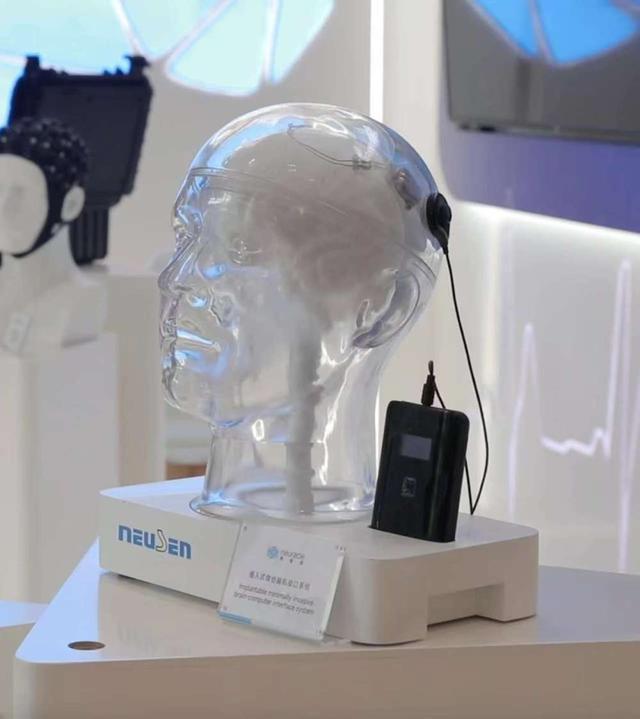
Taking BCI from the laboratory to scaled clinical use has never been limited by chips and algorithms alone. A flexible electrode must operate stably for years in a moist, high-salt, constantly micro-moving brain environment. A cranial implant must simultaneously meet biocompatibility, mechanical matching and zero signal interference requirements. The ultimate carrier of these demands is a group of specialty engineering plastics redefined by the word “implantable.”
Three Material Routes, Three Levels of Admission
Demand for engineering plastics in BCI has clearly split into three tiers, each with a very different admission logic.
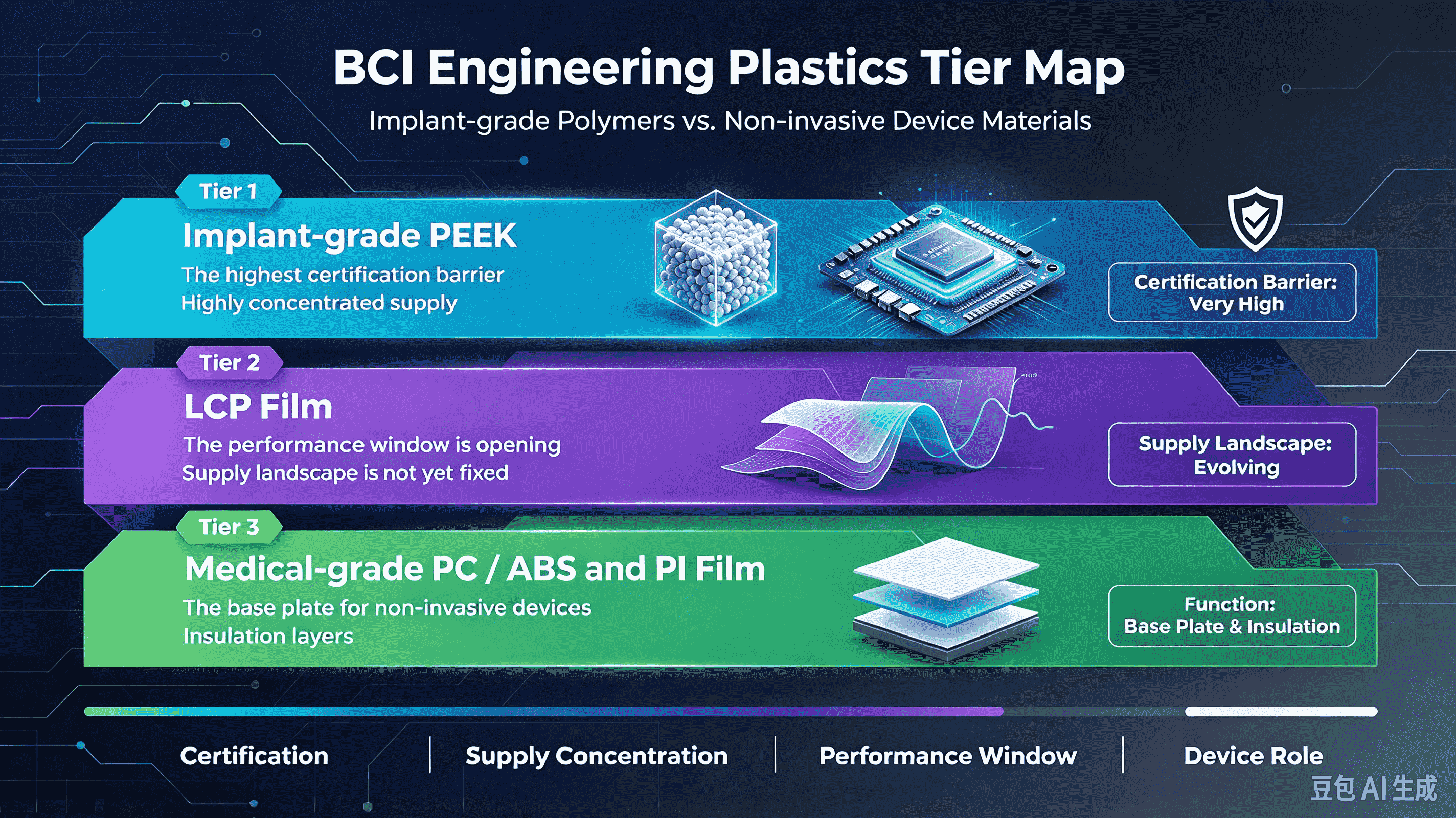
Tier 1: Implant-grade PEEK — the highest certification barrier and highly concentrated supply. For invasive BCI, cranial connector plates, electrode carriers and encapsulation structures are pushing PEEK from its mature orthopedic implant applications into a more demanding scenario. PEEK’s electrical neutrality—it does not conduct electricity or heat—physically reduces interference with weak neural electrical signals, an inherent advantage that metal materials struggle to replace. The key point, however, is that the PEEK required for invasive BCI “is not industrial grade—it must be implant grade.” This market has long been dominated by three players: Victrex (UK), Solvay (US) and Evonik (Germany). The barrier in implant-grade PEEK is not polymerization capacity, but a complete biocompatibility data package: systemic toxicity, genotoxicity, carcinogenicity, hemocompatibility and implantation response—each requiring years of accumulation and regulatory endorsement. For import engineering plastics traders, the value at this tier is not “finding alternative sources,” but whether we can secure compliant supply of implant-grade grades from the three original manufacturers and help downstream customers complete the transition from industrial grade to implant grade.
Tier 2: LCP film — the performance window is opening, and the supply landscape is not yet fixed. If PEEK solves “structural load-bearing + signal non-interference,” LCP film solves “efficient signal transmission + long-term dimensional stability.” Flexible BCI electrodes need a material with extremely low water absorption (LCP film <0.04%), minimal loss for high-frequency weak neural signals, and biocompatibility. This combination makes LCP film an ideal candidate for flexible electrode substrates and encapsulation. Unlike the implant-grade PEEK market, which is dominated by three giants, high-end LCP film supply is still mainly led by Japanese and Korean companies (Kuraray, Murata, Sumitomo Chemical, Toray, etc.), but Chinese companies have achieved full-chain breakthroughs from resin synthesis to film forming and have entered joint development and clinical validation with overseas BCI customers. This means the LCP film supply window is not yet closed, and traders still have room to build differentiated supply combinations in this category.
Tier 3: Medical-grade PC/ABS and PI film — the “base plate” for non-invasive devices and insulation layers. The housings and contact parts of non-invasive BCI devices are bringing medical-grade PC/ABS alloys and medical-grade silicone into a standardized compliance framework. Skin-contact parts must pass ISO 10993 series cytotoxicity, sensitization and irritation tests, while non-contact parts can use PC/ABS alloys. PI film serves as the insulating layer material for flexible electrodes, forming the upper and lower layers of a “sandwich structure” for encapsulation and insulation; commonly used materials also include PDMS, Parylene-C and SU-8 resin. The certification barrier at this tier is lower than implant-grade PEEK, but demand volume is larger and customers are more widely distributed—making it the first segment in which engineering plastics trading can generate stable shipments in the BCI track.
What This Means for Import Engineering Plastics Trading
The publication of the BCI international standard will not create huge plastics purchase orders in the short term. In 2026, brokerage forecasts for Kontour Medical’s BCI supporting business revenue are only in the range of RMB 20–50 million. But it sends a more important signal: BCI material selection is moving from “research customization” to “standard constraint.” Once the reference architecture establishes an interoperability framework at the system level, downstream device manufacturers will increasingly cite existing medical material standards (ISO 10993, YY/T 0660, etc.) when selecting materials, rather than validating each case from scratch. For material suppliers and traders already holding compliance documents for implant-grade or medical-grade grades, this constitutes a first-mover advantage.
For an import engineering plastics trading company, the pragmatic approach is not to bet on which single material will become the “only winner,” but to build three parallel supply capabilities: lock in compliant grade channels from Victrex, Solvay and Evonik for implant-grade PEEK to serve cranial carrier and encapsulation customers; track domestic and overseas suppliers of LCP film and PI film that have entered clinical validation to provide multi-source options for non-invasive and flexible electrode customers; and cover mass-production demand for device housings and contact parts with medical-grade PC/ABS and medical-grade silicone grades backed by complete ISO 10993 test data.
The BCI “standards breakthrough” is a starting point, not an endpoint. What truly determines how far this track can go is the ability of materials to “stay in place and transmit accurately” inside the body and on the body surface. For engineering plastics trading, the opportunity lies precisely on the other side of that sentence: whoever can help customers cross the “implant-grade” and “medical-grade” compliance thresholds will occupy a position in the BCI supply chain that is difficult to bypass.