
- English
- 简体中文
- Español
- Português
- русский
- Français
- 日本語
- Deutsch
- tiếng Việt
- Italiano
- Nederlands
- ภาษาไทย
- Polski
- 한국어
- Svenska
- magyar
- Malay
- বাংলা ভাষার
- Dansk
- Suomi
- हिन्दी
- Pilipino
- Türkçe
- Gaeilge
- العربية
- Indonesia
- Norsk
- تمل
- český
- ελληνικά
- український
- Javanese
- فارسی
- தமிழ்
- తెలుగు
- नेपाली
- Burmese
- български
- ລາວ
- Latine
- Қазақша
- Euskal
- Azərbaycan
- Slovenský jazyk
- Македонски
- Lietuvos
- Eesti Keel
- Română
- Slovenski
- मराठी

ISO Certifications in Engineering Plastics Plants: From a Baseline to a Differentiator
Walk into any large scale engineering plastics production site, and you will almost certainly see ISO certification plaques on the wall—they have become a standard fixture. But what exactly do these alphanumeric codes mean when it comes to procurement decisions, supplier audits, or even product exports? And what are the real differences between the various certifications? Taking three global leaders—BASF, SABIC, and Celanese—as examples, this article breaks down the common ISO standards found in engineering plastics plants and assesses their practical value.
________________________________________
I. ISO 9001: The Bedrock of Consistent Quality
Many people interpret ISO 9001 simply as "quality approval," but its core lies in "systematically ensuring ongoing conformity"—from incoming material inspection and in process parameter monitoring to finished product traceability, every step is supported by documented procedures and implementation records.
BASF’s polyurethane facility in Lemförde, Germany, and its engineering plastics line at the Zhanjiang Verbund site in China both use ISO 9001:2015 as the fundamental framework for quality management. SABIC has been implementing Total Quality Management (TQM) across all its global petrochemical sites since the 1980s and mandates ISO 9001 certification as a hard requirement for each plant. Celanese also treats this standard as the starting point for quality control in its engineering plastics business.
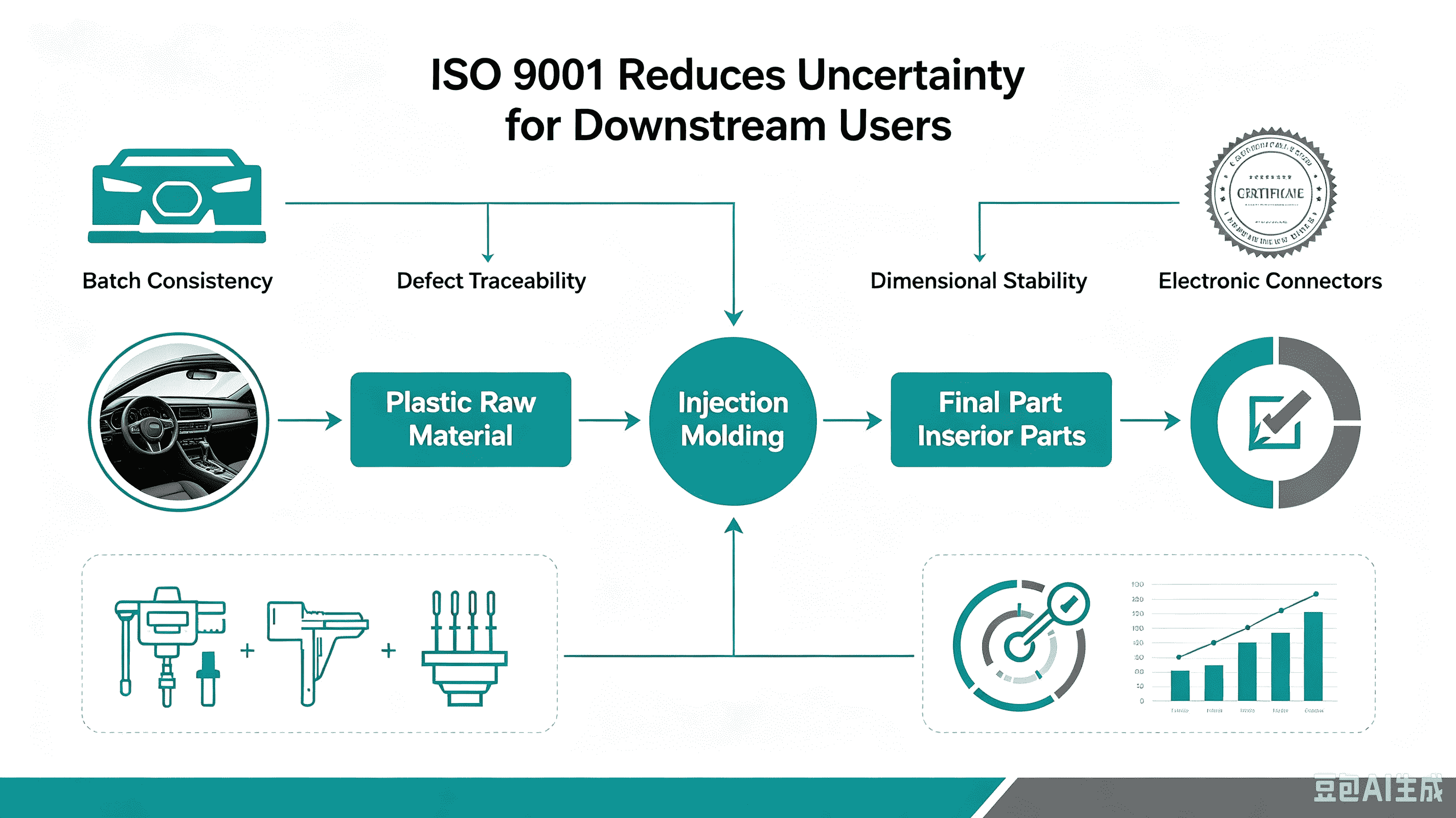
For downstream users, a supplier with ISO 9001 means that batch to batch property variations are kept within predictable limits, and any product defects can be traced back to specific process steps—this is especially critical in demanding applications such as automotive interior parts and electronic connectors, where dimensional stability is paramount.
________________________________________
II. ISO 14001: The Passport to Cross Environmental Barriers
With the ongoing evolution of the EU’s Carbon Border Adjustment Mechanism (CBAM) and REACH regulations, the environmental profile of engineering plastics is no longer just a corporate social responsibility—it directly affects whether products can enter certain markets. ISO 14001 environmental management system certification provides authoritative evidence that a plant systematically manages wastewater, air emissions, solid waste, and energy consumption.
SABIC’s global engineering thermoplastics compounding facilities are all ISO 14001:2015 certified, with environmental control checkpoints throughout the entire process—from raw material storage to extrusion and pelletising. BASF’s Zhanjiang engineering plastics unit also holds this certification, ensuring a reduced environmental footprint from the source. Celanese runs ISO 14001 independently alongside its quality system, maintaining parallel quality and environmental management.
Products from ISO 14001 certified plants often clear customs and customer audits more smoothly, especially for orders destined for Europe, Japan, or South Korea. For these markets, this certification is virtually an entry ticket.
________________________________________
III. ISO 45001: Safe Operations Ensure Uninterrupted Supply
Safety incidents in chemical production not only threaten employee health but can also shut down production lines and delay deliveries. ISO 45001 occupational health and safety management requires plants to systematically identify hazards—such as mechanical injuries, chemical leaks, and dust explosions—and to establish preventive and emergency response mechanisms.
BASF’s Lemförde plant and multiple SABIC production sites hold ISO 45001 certification. In recent years, Chinese engineering plastics compounders have also been accelerating the integration of ISO 9001, ISO 14001, and ISO 45001 into a single "three in one" system. This is not only a compliance measure but also a hidden guarantee of supply chain stability—plants with frequent safety incidents can hardly maintain a reliable on time delivery record.
________________________________________
IV. Advanced Industry Specific Certifications: Precision Matched to Applications
The three general purpose systems above are the baseline, but engineering plastics serve an extremely wide range of downstream industries. Leading plants also apply for industry specific certifications tailored to their target customers, and these often determine whether they can enter high value added segments.
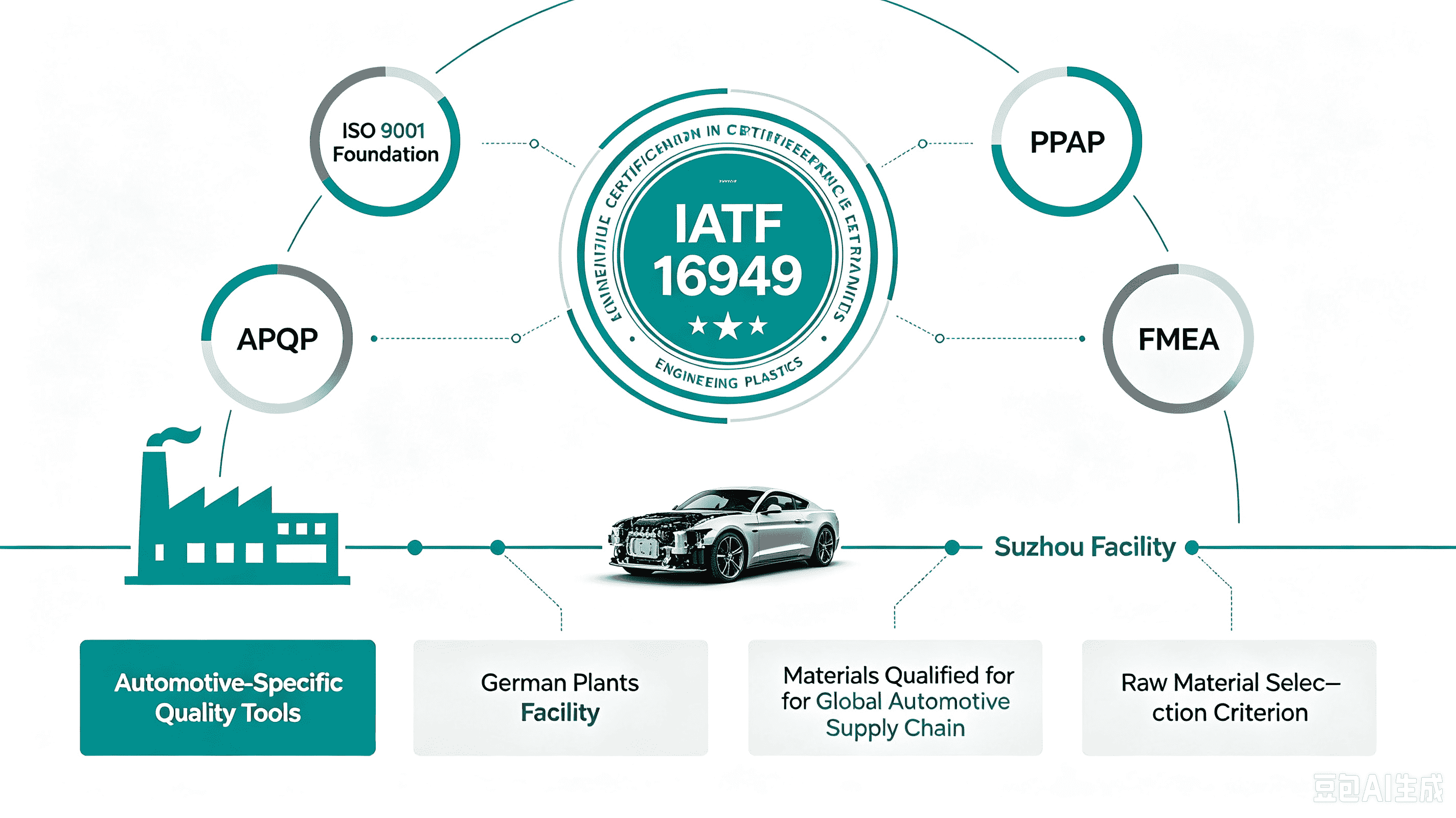
• IATF 16949 (automotive) : This builds on ISO 9001 by adding automotive specific tools such as APQP, PPAP, and FMEA. BASF’s German plants and Celanese’s Suzhou facility both hold this certification, meaning their materials are already qualified for the global automotive supply chain. For automotive parts manufacturers, this certification is the primary criterion for raw material selection.
• ISO 13485 (medical devices) : Facilities handling medical grade PEEK, PC, and similar materials must meet this standard, which imposes stricter controls than general industrial products, covering biocompatibility, cleanliness, and sterilisation adaptability.
• ISO 50001 (energy management) : BASF has already achieved this certification at some of its sites. As carbon footprint awareness grows, this certification is increasingly becoming a differentiator for multinational buyers.
________________________________________
V. Reading the Certification Portfolio to Understand a Plant’s DNA
A plant’s certification list can quickly outline its capability boundaries and market positioning:
• ISO 9001 only → a general purpose supplier suitable for cost driven, routine applications.
• ISO 9001 + ISO 14001 + ISO 45001 → a well managed, comprehensive plant capable of supplying multiple products across various regions.
• Extra IATF 16949 or ISO 13485 → a specialist supplier targeting automotive, medical, or other high requirement industries.
• ISO 50001 → low carbon manufacturing capability, aligned with ESG oriented procurement trends.
________________________________________
ISO standards are not just wall decorations; they are an executable and verifiable management language. For engineering plastics professionals in procurement, quality, and technical roles, understanding what these codes actually mean offers far more insight into a supplier’s soft capabilities than simply looking at test data. The next time you review a factory’s report, treat the certification section as a map—it shows not only compliance, but also how far that plant can take you.