
- English
- 简体中文
- Español
- Português
- русский
- Français
- 日本語
- Deutsch
- tiếng Việt
- Italiano
- Nederlands
- ภาษาไทย
- Polski
- 한국어
- Svenska
- magyar
- Malay
- বাংলা ভাষার
- Dansk
- Suomi
- हिन्दी
- Pilipino
- Türkçe
- Gaeilge
- العربية
- Indonesia
- Norsk
- تمل
- český
- ελληνικά
- український
- Javanese
- فارسی
- தமிழ்
- తెలుగు
- नेपाली
- Burmese
- български
- ລາວ
- Latine
- Қазақша
- Euskal
- Azərbaycan
- Slovenský jazyk
- Македонски
- Lietuvos
- Eesti Keel
- Română
- Slovenski
- मराठी

Behind the Blade Battery Revolution: The 'Invisible Battlefield' of Specialty Engineering Plastics
March 5, 2026 – BYD officially unveiled its second generation Blade Battery in Shenzhen. Key specs include: 5 minute fast charge from 10% to 70% SOC at ambient temperature, 9 minutes from 10% to 97%; in extreme cold (−30°C), 12 minutes from 20% to 97%; system energy density of 190–210 Wh/kg – a 35%–50% improvement over the first generation; and a cycle life of 3,300–4,000 cycles. These numbers are not just a leap in battery technology – they also signal a profound transformation in materials science.
________________________________________
1. From “Long Blade” to “Short Blade”: Structural Evolution Demands Material Upgrades
The second generation Blade Battery adopts a 0.6 meter “short blade” cell design, compared to the 1.2 meter long blade of the original. The shorter format improves heat dissipation, reduces internal stress, and boosts manufacturing yield. Combined with CTB 2.0 (cell to body) integration, the pack achieves a volumetric efficiency of 75.4%–76%. A more compact and highly integrated architecture means every millimetre inside the pack must be optimally utilised – placing unprecedented demands on the strength, thermal resistance, insulation, and flame retardancy of structural components.
Traditional metals are approaching their limits in weight reduction. Specialty engineering plastics, with their “plastic instead of metal” advantages, are stepping into the spotlight as critical enablers of this revolution.
________________________________________
2. Four Key Application Areas for Specialty Engineering Plastics
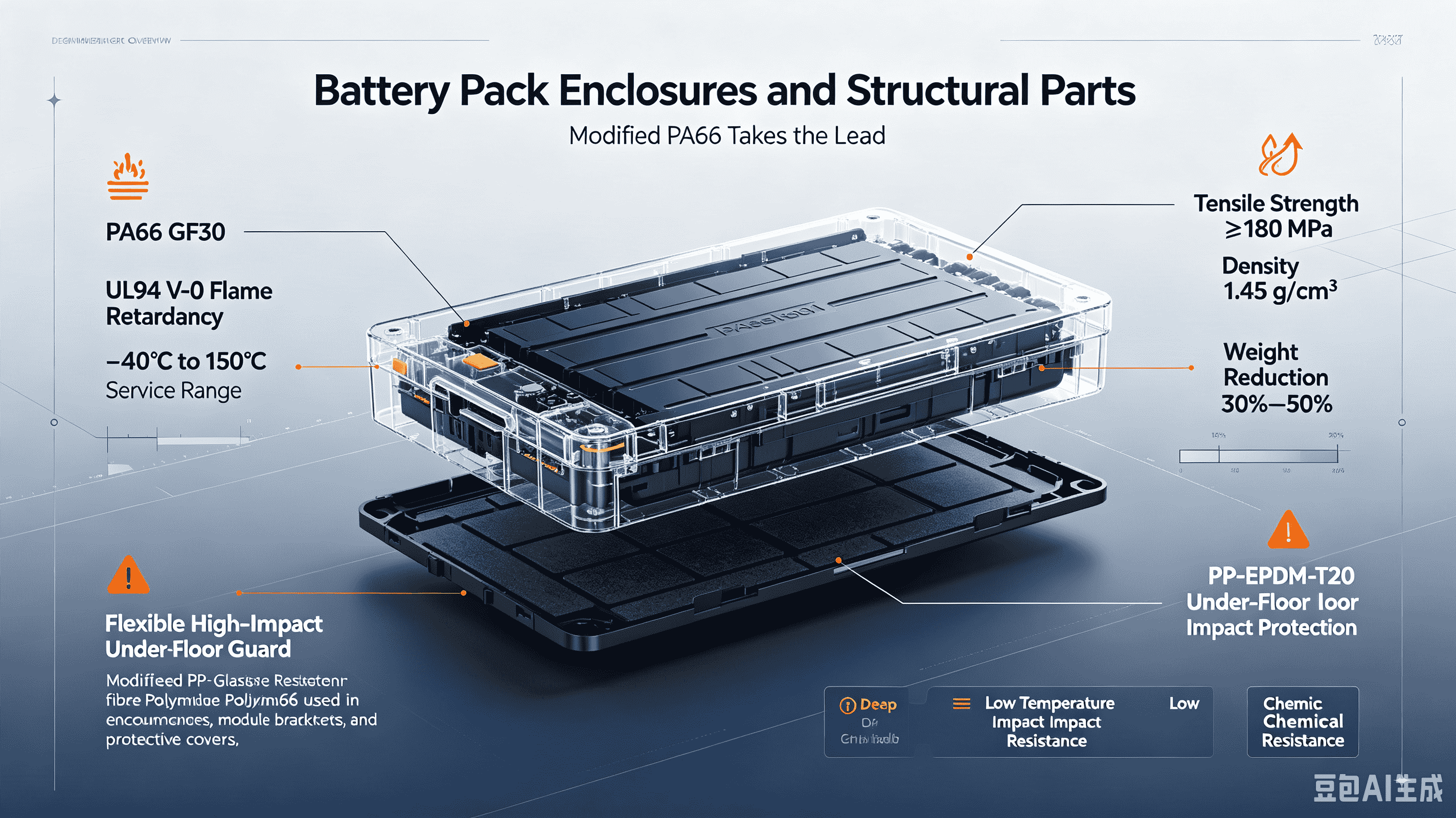
2.1 Battery Pack Enclosures and Structural Parts – Modified PA66 Takes the Lead
In the second gen Blade Battery pack, materials such as modified PA66 GF30 (glass fibre reinforced polyamide 66) are widely used for enclosures, module brackets, and protective covers. With UL94 V 0 flame retardancy, a service temperature range of –40°C to 150°C, tensile strength ≥180 MPa, and a low density of just 1.45 g/cm³, this material perfectly balances safety, strength, and lightweighting. In practice, replacing metal with such polymers can reduce weight by 30%–50% in battery enclosures and body structural components.
For under floor impact protection, modified PP EPDM T20 (high impact polypropylene) is used, offering excellent low temperature impact resistance, chemical resistance, and cost effectiveness.
2.2 High Voltage Insulation and Safety Protection – LCP for Extreme Conditions
As the second gen Blade Battery is paired with an 800 volt (and soon 1000 volt) high voltage platform, electrical insulation has become a top priority in material selection. Solvay’s Xydar® LCP G 330 HH (liquid crystal polymer) maintains outstanding dielectric properties even after 30 minutes of exposure to 400°C – and it is inherently flame retardant without halogenated additives, making it ideal for insulation plates in high voltage modules. In addition, high CTI modified PPO (polyphenylene oxide) – with a comparative tracking index ≥600 V – is used for high voltage component housings and electronic control protection parts, fully compatible with 1000 V systems.
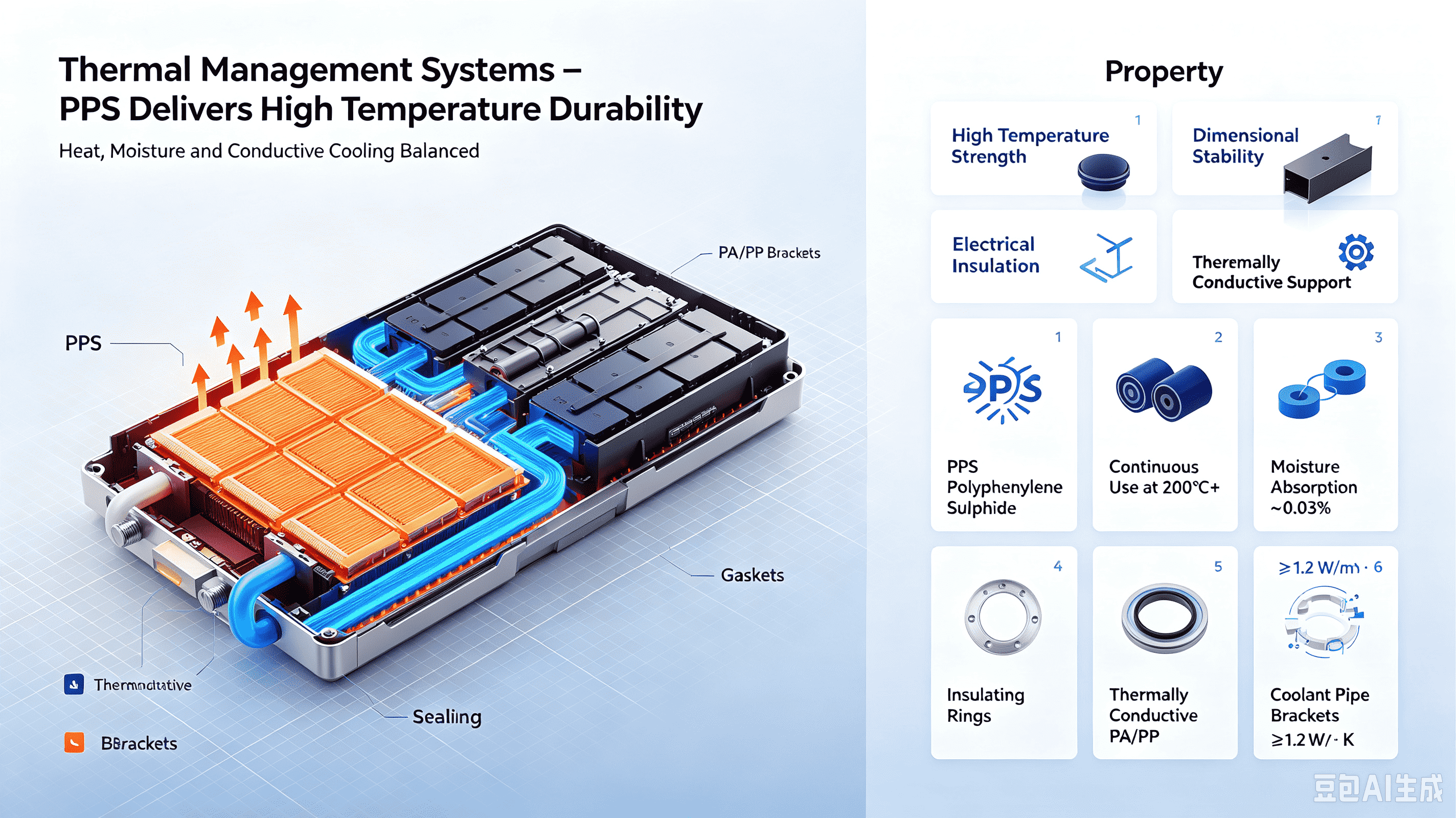
2.3 Thermal Management Systems – PPS Delivers High Temperature Durability
Batteries generate substantial heat during charge/discharge cycles, especially under high loads. PPS (polyphenylene sulphide) can maintain structural integrity at 200°C and above over the long term, and its extremely low moisture absorption (around 0.03%) ensures dimensional stability in humid environments. In battery modules, PPS is injection moulded into brackets, connectors, and side plates; it is also used for negative electrode insulating rings, positive/negative pole insulator gaskets, and sealing rings in cover assemblies. For cooling system components, thermally conductive PA/PP compounds (thermal conductivity ≥1.2 W/m·K) are employed in coolant pipe brackets.
2.4 Pursuing Ultimate Lightweighting – PEEK Opens New Horizons
In premium applications where every gram counts, PEEK (polyether ether ketone) is gaining traction. PEEK based structural parts can significantly enhance battery safety and service life. For example, NAPON New Materials recently introduced a PPS based thermoplastic composite battery pack solution that reduces weight by 5.61 kg (from 8.34 kg to 2.73 kg) compared to steel, while passing the most stringent fire resistance tests.
________________________________________
3. A Billion RMB Market Opportunity
The demand for specialty engineering plastics in new energy vehicles (NEVs) is soaring. While a conventional ICE vehicle uses about 700 grams of PPS, that figure jumps to over 2,500 grams in an NEV. In 2024, domestic automotive PPS consumption reached 21,000 tonnes, of which NEVs accounted for 12,000 tonnes. PEEK demand in the NEV sector is projected to hit 1,800 tonnes by 2025, with a compound annual growth rate of 18.7%.
At the macro level, China’s specialty engineering plastics market has grown from RMB 7.2 billion in 2018 to RMB 16.0 billion in 2024, and is expected to reach RMB 21.2 billion by 2027. In the supply chain for the second gen Blade Battery structural materials, Kingfa Sci. & Tech. holds approximately 30% market share, while Pret Composites accounts for 15%–20%, with a per vehicle material value of about RMB 120–150.
________________________________________
4. Conclusion
The launch of the second generation Blade Battery has pushed EV fast charging performance to parity with refuelling a conventional car – but equally important is the materials revolution happening beneath the surface. From modified PA66 to PPS, from LCP to PEEK, specialty engineering plastics are moving from supporting roles to centre stage, becoming indispensable pillars of next generation battery technology. For importers and traders of engineering plastic raw materials, this represents not just a multi billion RMB market opportunity, but also a strategic window to embed deeply into the NEV supply chain and build long term partnerships with leading battery manufacturers.