
- English
- 简体中文
- Español
- Português
- русский
- Français
- 日本語
- Deutsch
- tiếng Việt
- Italiano
- Nederlands
- ภาษาไทย
- Polski
- 한국어
- Svenska
- magyar
- Malay
- বাংলা ভাষার
- Dansk
- Suomi
- हिन्दी
- Pilipino
- Türkçe
- Gaeilge
- العربية
- Indonesia
- Norsk
- تمل
- český
- ελληνικά
- український
- Javanese
- فارسی
- தமிழ்
- తెలుగు
- नेपाली
- Burmese
- български
- ລາວ
- Latine
- Қазақша
- Euskal
- Azərbaycan
- Slovenský jazyk
- Македонски
- Lietuvos
- Eesti Keel
- Română
- Slovenski
- मराठी

From Pellet to Part: Unmasking the "Transformation" of Engineering Plastics
In the realm of high-end manufacturing, the life of a rugged gear, a transparent headlamp lens, or a lightweight aircraft interior profile often begins as a seemingly insignificant, rice-grain-sized plastic pellet. How are these engineering plastic pellets endowed with precise shapes and superior performance? Behind this lies a "transformation" story that integrates materials science, thermodynamics, and precision mechanics. For professionals in design, procurement, and manufacturing, understanding these core processes is key to accurate material selection, design optimization, and achieving cost reduction and efficiency enhancement.
I. The "Three Pillars" of Basic Processes: The Foundation Shaping Countless Products
The vast majority of plastic products originate from one of the following three most classic and widely applied processing techniques. They determine the fundamental form and production efficiency of a product.
1. Injection Molding: The King of Precision and Mass Production
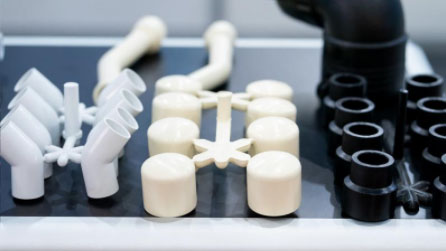
This is the preferred process for manufacturing complex three-dimensional structural parts. Its principle involves heating and melting plastic pellets within a barrel, then applying high pressure via a screw to inject the melt at high speed into a closed mold cavity. After cooling and solidification, the part is ejected. It resembles precision metal casting, but is significantly faster. Injection molding's advantages lie in its high dimensional accuracy, repeatable consistency, and excellent surface detail, making it ideal for mass-producing complex functional parts like gears, housings, and connectors. Well-known materials such as POM and Nylon are often processed using this method.
2. Extrusion: The Birthplace of Continuous Profiles
If you require continuous long products with a constant cross-sectional shape, the extrusion process is the ideal choice. Plastic pellets are continuously fed into an extruder, where they are melted and homogenized by a rotating screw. Finally, the melt is forced through a "die" of a specific shape, forming pipes, rods, sheets, or profiles. The process resembles making noodles, but with much higher technical sophistication. Extrusion is the core technology for producing linear products like window frames, pipes, sheets, and wire/cable insulation.
3. Blow Molding: The Art of Hollow Parts
To obtain hollow plastic products, such as various bottles, containers, fuel tanks, or automotive air ducts, blow molding is the primary technique. The process is akin to glassblowing: first, a molten tube of plastic, called a "parison," is formed. This parison is then placed inside a mold, and compressed air is blown into it, causing it to expand and conform to the mold cavity's walls. Upon cooling, a hollow product is obtained. Blow molding enables lightweight, high-strength, integrated hollow parts, making it irreplaceable in packaging and industrial containers.
II. Advanced and Specialized Processes: Meeting Higher Challenges
As product demands become increasingly stringent, numerous specialized processing technologies have emerged:
• Thermoforming: This process involves heating an extruded plastic sheet until it softens and then using vacuum or air pressure to form it against a mold. It's widely used for manufacturing large, curved parts like refrigerator liners and aircraft cabin interior panels.
• Rotational Molding: Powdered plastic is placed inside a mold that rotates biaxially while being heated. The plastic melts and coats the entire inner surface of the mold uniformly. This technique is particularly suitable for producing very large, seamless hollow articles like large storage tanks and playground equipment.
III. The Synergy of Process and Material: The Key to Success
"There is no single best process, only the one that is most suitable for the material and application." The choice of process is primarily dictated by the product's design, dimensions, and functional requirements. However, a more critical step is the deep coupling between the process and the material's specific properties. For example:
• PA6 (Nylon 6) with its excellent flowability, is ideal for the rapid injection molding of thin-walled, complex parts.
• PC (Polycarbonate) sheets, possessing high melt strength, are the ideal choice for thermoforming transparent protective shields.
• UHMWPE (Ultra-High Molecular Weight Polyethylene) , due to its extremely high viscosity, is typically not suitable for conventional injection molding or extrusion and requires special processes like compression molding and sintering.